
Table of Contents
- How Herbal Medicine Supports Immune Function
- TGA Regulation of Herbal Medicines: What You Need to Know
- Traditional Chinese Medicine Immune Support
- The Herbal Medicine Consultation Process
- Key Benefits of Herbal Medicine for Immunity
- Safety, Interactions, and Working with Your Doctor
- Frequently Asked Questions
Last Updated: September 21, 2026
How Herbal Medicine Supports Immune Function
Herbal medicine for immunity works by supporting the body’s own defence systems rather than attacking pathogens directly. Many herbs contain compounds that interact with the endocrine system, gut microbiome, and inflammatory pathways. This guide from Acupuncture examines what the evidence supports, what it does not, and how to use herbal medicine safely alongside conventional care. (Source: Therapeutic Goods Administration guidance on complementary medicines)
The immune system is not a single organ. It is a network of cells, tissues, and signalling molecules distributed throughout the body, and its performance depends heavily on sleep, stress, nutrition, and metabolic health. Herbal traditions have long treated immune resilience as a whole-body outcome rather than a target to be stimulated.
TGA Regulation of Herbal Medicines: What You Need to Know
The TGA regulates herbal medicines in Australia through two main pathways, and understanding which one applies to a product tells you a lot about what has actually been assessed. This is the single most useful piece of consumer knowledge in this entire topic.
Registered vs. Listed Medicines
Registered medicines (AUST R) have been individually evaluated for quality, safety, and efficacy. Listed medicines (AUST L) are assessed for quality and safety but not for efficacy, and they may only make limited, low-level claims. Most herbal products on shelves carry an AUST L number.
| Category | Assessment | Claims Allowed | Typical Products |
|---|---|---|---|
| Registered (AUST R) | Quality, safety, efficacy | Specific therapeutic claims | Some standardised extracts |
| Listed (AUST L) | Quality and safety only | Low-level, permitted claims | Most herbal supplements |
| Practitioner-only | Varies by supplier | Clinical guidance required | Dispensed formulas |
A common mistake is assuming an AUST L number means the product has been proven to work. It confirms the product is legally supplied, not that it treats any particular condition. Check the ARTG entry before buying.
Traditional Chinese Medicine Immune Support
Traditional Chinese Medicine approaches immune support by assessing patterns of imbalance rather than naming a single pathogen. A practitioner looks at sleep, digestion, temperature regulation, stress, and menstrual or hormonal patterns together, then selects herbs and acupuncture points to address the underlying pattern.
Common Herbs Used in TCM for Immune Health
Several herbs appear repeatedly in classical formulas, though individual suitability varies:
- Astragalus (Huang Qi): traditionally used for fatigue and defensive qi; often included in long-term support formulas
- Ginseng (Ren Shen): used for depleted energy and recovery; not suitable during acute illness in traditional practice
- Schisandra (Wu Wei Zi): traditionally used for cough and to support resilience
- Elderberry and echinacea: Western herbs with overlapping traditional use, frequently combined with TCM formulas
The Herbal Medicine Consultation Process
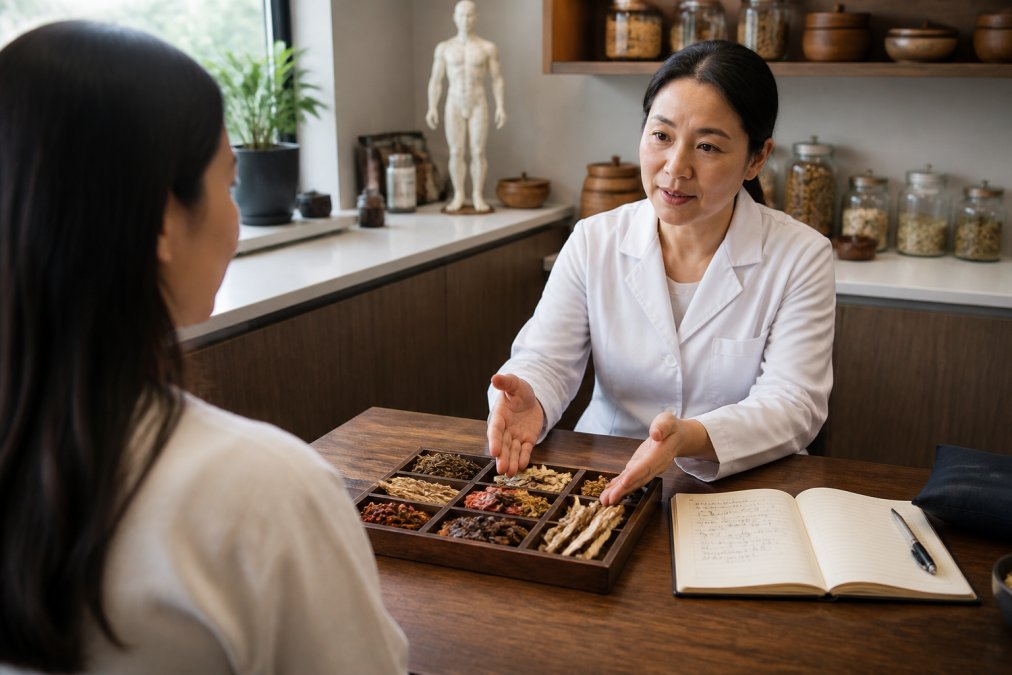
A herbal medicine consultation is a structured assessment, not a quick product recommendation. A thorough first appointment typically runs longer than a standard GP visit because the practitioner needs a full picture before prescribing anything.
What to Expect During Your First Appointment
Expect a detailed history covering current symptoms, medical conditions, medications, diet, sleep, stress levels, and menstrual or hormonal patterns where relevant. Bring a list of everything you take, including supplements and over-the-counter medicines.
Photograph the labels of every supplement and medication you take before your appointment. It removes guesswork from the interaction check and saves time during the consultation.
::: (Source: evidence supporting the use of specific herbs for immune health)
Key Benefits of Herbal Medicine for Immunity
The realistic benefits of herbal medicine for immunity centre on supporting the conditions the immune system depends on, rather than directly boosting it. Sleep quality, stress regulation, blood sugar control, and gut health all influence immune function, and several herbs have traditional and emerging evidence for supporting these areas. What most guides skip is the mechanism, how a herb actually touches an immune pathway, and that is where the useful detail sits.
Stress and Sleep: The Cortisol-Immune Axis
Adaptogens such as withania (Withania somnifera) and rhodiola (Rhodiola rosea) are traditionally used to support the body’s response to stress. The mechanism matters: sustained cortisol elevation suppresses secretory IgA and shifts immune signalling toward a pro-inflammatory state, which is why chronic stress shows up as frequent colds and slow recovery. Herbs in this class are used to modulate the stress response, not to sedate.
Digestive Support and the Gut-Immune Interface
A large proportion of immune tissue sits in the gut wall, and the microbiome trains much of that tissue. Herbs traditionally used for digestive support, ginger, gentian, and bitter greens, are thought to work partly by supporting digestion and gut barrier function rather than by acting on immune cells directly. This is an indirect benefit, and it is honest to describe it that way.
Anti-Inflammatory Support: Turmeric and Ginger
Turmeric (Curcuma longa) and ginger (Zingiber officinale) are traditionally used where low-grade inflammation is a factor. Curcumin, the active in turmeric, is poorly absorbed on its own, which is why traditional formulas pair it with black pepper or fats, and why standardised extracts use absorption-enhancing technology. This is a concrete example of why the form and delivery of a herb matter as much as the herb itself.
Recovery Support After Illness
Herbs used after illness aim to restore energy and appetite rather than fight infection. In traditional practice this is a distinct phase, you do not use the same formula during acute illness as you do during recovery. Astragalus is a common example: traditionally used for fatigue and defensive qi, it is typically introduced after the acute phase, not during it.
What the Evidence Does and Does Not Support
Where evidence is limited, that should be stated plainly. Many traditional uses have not been confirmed in large clinical trials, and absence of evidence is not the same as proof of benefit. A herb being traditional does not make it effective for every condition, and no herbal product should be presented as a cure for a diagnosed disease.
The strongest case for herbal medicine in immune support is as part of a broader lifestyle approach, not as a standalone treatment. Pair it with sleep, nutrition, and stress management for the best chance of a meaningful result, and judge each herb on its own evidence, not on the category as a whole.
Safety, Interactions, and Working with Your Doctor
Herbal medicines can interact with prescription medication, and this is the area where most harm occurs. The interaction is not always obvious, because herbs can affect how the liver breaks down a drug, how quickly it is cleared, or how strongly it acts at its target. St John’s wort is the best-documented example: it induces liver enzymes that clear several prescription medicines faster, which can reduce the effectiveness of some antidepressants and oral contraceptives.
Common Interaction Patterns to Know
- Blood-thinning medication: some herbs affect platelet function or bleeding time, so they are used cautiously alongside anticoagulants and antiplatelets
- Thyroid medication: herbs that influence thyroid function can change how much replacement hormone is needed, so levels are monitored rather than assumed
- Blood sugar medication: herbs traditionally used for metabolic support can add to the effect of glucose-lowering drugs
- Immunosuppressants: herbs that stimulate immune activity may work against medication designed to suppress it
This is why a full medication list, including supplements, over-the-counter medicines, and anything prescribed by a specialist, is not optional. It is the starting point for any safe recommendation.
When to Get Blood Tests Before Treating Anything
Blood tests can clarify what is actually happening before you treat anything. Thyroid function, iron studies, vitamin D, and hormone panels are common starting points, and results give you and your practitioner a baseline to work from. This matters because fatigue, low mood, and frequent illness can look like an immune problem when the underlying driver is a thyroid issue, low iron, or a vitamin deficiency.
Age and Life Stage Change What Is Appropriate
Hormonal fluctuations during perimenopause and menopause change what support is appropriate, and the same formula rarely suits a 25-year-old and a 55-year-old. During pregnancy and breastfeeding, the list of suitable herbs narrows considerably, and some traditionally popular herbs are avoided entirely. Before surgery, several herbs need to be stopped in advance because of bleeding or blood pressure effects.
Do not stop or change prescribed medication to try herbal alternatives. Any change should be managed with your prescribing doctor, and herbal support should sit alongside conventional treatment, not replace it. If you are pregnant, breastfeeding, preparing for surgery, or managing a chronic condition, get clearance before starting anything.
Frequently Asked Questions
How does herbal medicine support the immune system?
Herbal medicine aims to support immune function through several mechanisms. Some herbs contain compounds with antioxidant properties, while others may help modulate the body’s inflammatory response. Traditional systems like TCM focus on restoring balance to the body’s vital energy, or qi, which is believed to influence overall resilience. A qualified practitioner can recommend specific herbs based on your individual presentation, but it is important to remember that these are supportive measures, not treatments for disease.
Are herbal medicines regulated for safety and quality?
Yes, in Australia, the Therapeutic Goods Administration (TGA) regulates herbal medicines. Products must be listed or registered on the Australian Register of Therapeutic Goods (ARTG) before they can be legally sold. Listed medicines are considered lower risk and must contain only pre-approved ingredients. Registered medicines undergo a more rigorous assessment for specific health claims. Always check for an AUST L or AUST R number on the label to confirm TGA compliance.
Can herbal medicine be used alongside conventional treatments?
It can be, but only under professional guidance. Some herbs can interact with prescription medications, potentially reducing their effectiveness or causing adverse effects. For example, certain herbs may affect how the liver processes drugs or influence blood clotting. It is essential to inform both your herbalist and your medical doctor about all supplements you are taking. A qualified practitioner will assess potential interactions and work collaboratively with your healthcare team.
What should I look for when choosing a qualified herbalist?
Look for a practitioner with formal qualifications and membership in a professional association, such as the Australian Traditional-Medicine Society (ATMS) or the Chinese Medicine Board of Australia (CMBA). A qualified herbalist will conduct a thorough consultation, asking about your medical history, medications, and lifestyle. They should be transparent about their training, use TGA-compliant products from reputable suppliers, and be willing to communicate with your other healthcare providers.


