
Table of Contents
- How Online Herbal Medicine Consultations Work
- What to Expect in a Chinese Medicine Consultation
- How to Prepare for a Telehealth Herbal Appointment
- Benefits of Herbal Medicine for Immunity and Everyday Wellness
- Safety Screening and Who Should Check First
- Private Health Rebates and Insurance Eligibility
- Follow-Up Support and Delivery of Your Herbal Prescription
- Frequently Asked Questions
Last Updated: September 27, 2026
How Online Herbal Medicine Consultations Work
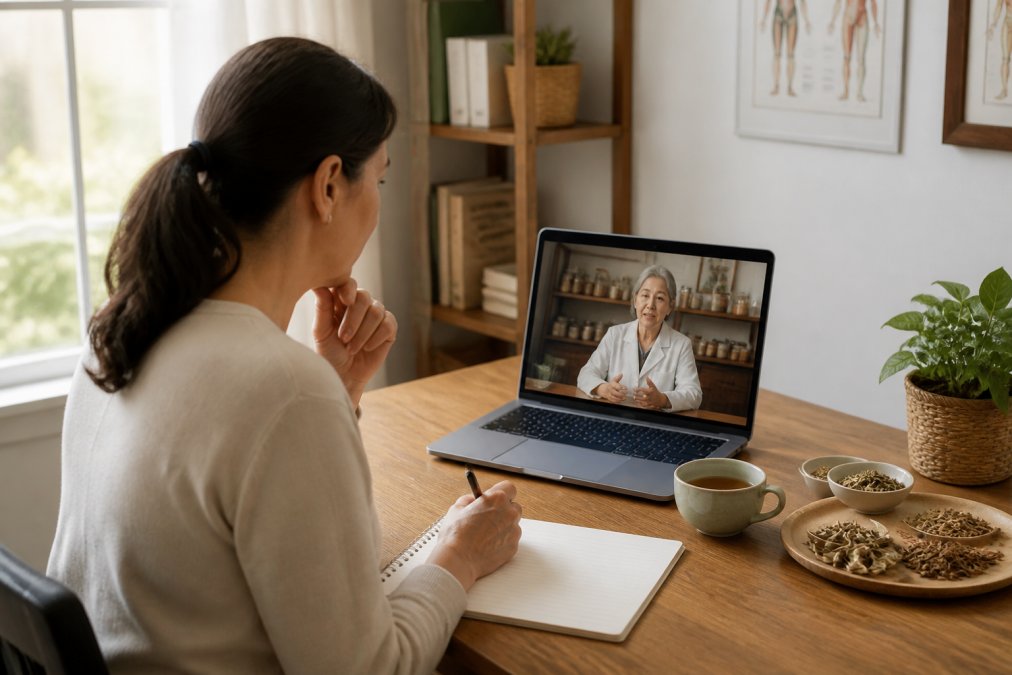
Booking a herbal medicine consultation online connects you with a qualified practitioner through a secure video call, where your full health history is reviewed before any prescription is dispensed. At Acupuncture, we run these appointments the same way we run in-person ones: unhurried, thorough, and built around your individual case rather than a template. (Source: Australian government’s Therapeutic Goods Administration (TGA))
The process follows a clear sequence:
- Book your appointment through the online booking system
- Complete a pre-consultation health questionnaire
- Join the video consultation at your scheduled time
- Receive your personalised herbal prescription
- Have your medicine dispensed and shipped to your door
Most initial appointments run longer than follow-ups because the practitioner needs a complete picture: your medical history, current medications, presenting symptoms, sleep, digestion, stress levels, and menstrual or hormonal patterns where relevant.
Technology Requirements for Your Video Consultation
You need three things: a device with a camera and microphone, a stable internet connection, and a private space where you can speak freely. A laptop, tablet, or smartphone all work. The secure platform we use runs in your browser, so there is nothing to download or install.
Test your camera and microphone before the appointment. A common mistake is joining from a noisy café or a shared office, then struggling to describe symptoms discreetly. Book a quiet room, have your medication list nearby, and allow a buffer of ten minutes before the call.
What to Expect in a Chinese Medicine Consultation
A Chinese medicine consultation begins with a detailed health assessment rather than a quick symptom checklist. The practitioner asks about your main concern, then works through body systems: digestion, sleep, energy, temperature regulation, emotional state, and for women, menstrual cycle details.
Tongue and pulse diagnosis, two cornerstones of traditional Chinese medicine, adapt to the telehealth format. Your practitioner will ask you to show your tongue on camera under natural light. Pulse reading cannot be done remotely, so a thorough verbal history and observation carry more weight. This is a genuine limitation of remote assessment, and any practitioner who claims otherwise is overselling the format.
Expect the first consultation to take around 45 to 60 minutes.
How to Prepare for a Telehealth Herbal Appointment
Preparation is what separates a productive appointment from a rushed one. Gather your current medications, supplements, recent blood test results, and any relevant specialist letters before the call. Have a written list of your top three concerns, ranked by how much they affect your daily life.
A few practical steps make a measurable difference:
- Note your sleep pattern for the three nights before the appointment
- Write down any symptoms that change with your cycle, if applicable
- List every medication and supplement, including doses
- Find a quiet, well-lit room with a stable internet connection
- Have water nearby and use the bathroom beforehand
Your Preparation Checklist
- Book your appointment and note the time zone
- Complete the pre-consultation health questionnaire
- Gather medication and supplement lists with doses
- Collect recent pathology or imaging results
- Write your top three health concerns in order of priority
- Test your camera, microphone, and internet connection
- Prepare a private, quiet space with good lighting
- Keep a notebook handy for the treatment plan
Photograph your supplement bottles and medication boxes before the call. Reading labels from memory is where most patients make errors, and a quick photo removes the guesswork entirely.
Benefits of Herbal Medicine for Immunity and Everyday Wellness
Herbal medicine is best understood as a supporting therapy that works alongside, not instead of, conventional care. Certain herbs have a long history of use in traditional practice for supporting the body’s normal immune response, and modern research continues to examine how those traditional applications hold up. The honest position is that herbal medicine supports general wellbeing and symptom management; it is not a substitute for medical treatment of a diagnosed condition, and no practitioner should suggest otherwise.
What the evidence actually supports
It helps to separate tradition from evidence. Some herbs have a reasonable body of published research behind them; others rest mainly on historical use. A few examples of herbs commonly discussed in the literature include:
- Ginger, studied for its effect on nausea, including in pregnancy and after surgery
- Turmeric (curcumin), examined for its anti-inflammatory properties, though absorption varies widely between formulations
- Echinacea, investigated for its role in supporting the immune response during colds, with mixed results across trials
- St John’s wort, studied for mild to moderate low mood, but with significant interactions with several prescription medicines
- Valerian, examined for sleep quality, with results that vary between individuals
Why consistency beats potency
What most guides miss is that consistency matters more than strength. A well-matched formula taken daily for several weeks typically produces more noticeable change than a stronger formula taken sporadically. Herbal medicine is not a single-dose intervention; it works with the body’s own rhythms, and those rhythms respond to steady input rather than occasional bursts.
Keep a simple daily note of sleep quality, energy, and digestion for the first two weeks of any new formula. Patterns that are invisible day to day become obvious over a fortnight, and that record gives your practitioner far better information at the follow-up than memory alone.
Safety Screening and Who Should Check First
Safety screening happens before any prescription is written, and it is the part of the process that deserves the most attention. Your practitioner will ask about pregnancy or breastfeeding, liver and kidney function, autoimmune conditions, and every medication you take, including over-the-counter drugs.
Never combine a new herbal prescription with existing medication without telling both your doctor and your herbal practitioner. Undisclosed interactions are the single most common cause of adverse reactions in complementary medicine.
Private Health Rebates and Insurance Eligibility
Most competitor pages skip this topic entirely, which is a problem because rebate eligibility is one of the first things people want to know before booking. Here is the practical picture.
The two separate questions
People often conflate two different things:
- Is the consultation rebatable?, This depends on whether your private health fund’s extras cover includes Chinese herbal medicine or a related modality, and whether the practitioner is recognised by that fund.
- Is the herbal prescription rebatable?, Generally, no. The medicine itself is usually an out-of-pocket cost, even when the consultation attracts a rebate. Budget for the two separately.
What to check with your fund
Private health insurance in Australia is regulated by the Australian Prudential Regulation Authority (APRA), and each fund sets its own rules for what extras cover includes. There is no single national standard for herbal medicine rebates, so the only reliable answer comes from your own fund.
When you call, ask three specific questions:
- Does my policy’s extras cover include Chinese herbal medicine consultations?
- Is this practitioner a recognised provider under my fund, and do they have a provider number?
- What documentation do you require for a claim, a receipt with specific details, a referral, or something else?
How claiming usually works
If the clinic has a HICAPS terminal and your fund supports on-the-spot claiming for that service, you may be able to claim the rebate at the time of your appointment, paying only the gap. If not, you will typically pay in full and then submit a claim through your fund’s app or website, attaching the receipt.
Medicare and telehealth
Medicare does not generally cover herbal medicine consultations, whether in person or via telehealth. Some chronic disease management plans arranged through your GP include allied health sessions, but herbal medicine is not typically one of the covered allied health professions under those plans. If you are unsure, ask your GP whether any part of your care plan could apply.
Rebate rules change. A service that was covered last year may not be covered this year, and funds periodically update their extras schedules. Always confirm current eligibility directly with your fund before booking, rather than relying on a page you read months ago.
Follow-Up Support and Delivery of Your Herbal Prescription
Your prescription is dispensed after the consultation and shipped directly to your address. Delivery timelines depend on your location and the dispensing schedule, so confirm the expected timeframe when you book. Practitioner-only medicines are dispensed through a certified herbal dispensary, which means the herbs are sourced and prepared to a consistent standard.
The first prescription is rarely the final one. Plan for at least one follow-up so your formula can be refined based on how your body actually responds.
Frequently Asked Questions
How do online herbal medicine consultations work?
You book an appointment through the clinic’s website, then attend a video consultation with a qualified practitioner. During the session, the practitioner reviews your health history, current symptoms and any medications, and may examine your tongue via the camera. If herbs are suitable, a personalised formula is dispensed and shipped to your address. Follow-up appointments are usually scheduled two to four weeks later to review progress and adjust the prescription.
Are herbal medicine practitioners regulated in Australia?
Chinese medicine practitioners, including those prescribing herbs, are registered with the Australian Health Practitioner Regulation Agency (AHPRA). Always check a practitioner’s credentials and association membership before booking a herbal medicine consultation online.
What should I prepare for my first herbal medicine consultation?
Have a list of your current medications, supplements and diagnosed conditions ready. Note your main symptoms, when they started and what makes them better or worse. Prepare a private, quiet space with a stable internet connection, and keep a glass of water nearby. If you have recent blood tests or medical reports, have them handy. This helps the practitioner build a complete picture and screen for any contraindications before recommending herbs.
Can herbal medicine be used alongside conventional medical treatments?
Herbal medicine is often used alongside conventional care, but some herbs can interact with prescription medicines, including blood thinners and thyroid medications. Always tell both your doctor and your herbal practitioner about everything you take. A qualified practitioner will screen for interactions during your remote assessment and adjust the therapeutic plan accordingly. Never stop or change a prescribed medication without speaking to your doctor first.


