
Last Updated: October 25, 2026
Quick Summary
Holistic fertility support in South Yarra combines acupuncture, herbal medicine, nutrition and lifestyle guidance to support reproductive health alongside, not instead of, medical treatment. We build each plan around your cycle, history and goals rather than applying a fixed protocol.
- Fertility acupuncture sessions run longer than standard treatments because assessment of your cycle history comes first.
- Acupuncture for IVF support is scheduled around stimulation, retrieval and transfer phases rather than a fixed weekly rhythm.
- Sperm production runs on a roughly three-month cycle, so preconception care is a two-person project.
- Practitioners of acupuncture and Chinese medicine must be registered with AHPRA, which you can verify independently.
- No responsible practitioner should promise a pregnancy or claim to cure a diagnosed condition.
Table of Contents
- What Holistic Fertility Support in South Yarra Actually Involves
- Fertility Acupuncture: What to Expect From a Session
- Acupuncture for IVF Support: Fitting Treatment Around Your Cycle
- Fertility Herbal Medicine and What to Check Before You Start
- Preconception Care and Lifestyle Support for Both Partners
- How to Choose and Verify a Fertility Support Practitioner
- Book a Consultation to Discuss Your Fertility Support Plan
- Frequently Asked Questions
What Holistic Fertility Support in South Yarra Actually Involves
Holistic fertility support is coordinated care that combines acupuncture, herbal medicine, nutrition and lifestyle guidance to support reproductive health alongside, not instead of, medical treatment.
The approach suits people preparing for natural conception, those moving through IVF, and anyone wanting steadier hormonal balance. It does not replace a fertility specialist.
Below, we break down what each therapy involves, what the evidence does and does not show, and how to check a practitioner’s credentials before you book.
The therapies that make up a holistic plan
A holistic fertility plan usually draws on several complementary therapies at once. The mix depends on your assessment, but the core options are consistent.
- Acupuncture: fine needles at specific points, used to support circulation, sleep and stress regulation
- Chinese herbal medicine: prescribed formulas taken between appointments, adjusted as your cycle changes
- Nutrition and preconception guidance: practical changes to support egg and sperm health
- Lifestyle and stress support: sleep, movement and nervous system regulation
- Remedial massage: muscular tension relief, particularly for people carrying desk-related strain
What most guides miss is that these are not separate services stacked on top of each other. A well-built plan sequences them around your cycle and your medical appointments. For a wider look at how integrative fertility care fits together, read our guide to integrative fertility support for women.
Fertility Acupuncture: What to Expect From a Session
A fertility acupuncture session typically runs longer than a standard treatment, because assessment takes time. Your first appointment covers your cycle history, medical investigations and treatment timeline before any needling begins.
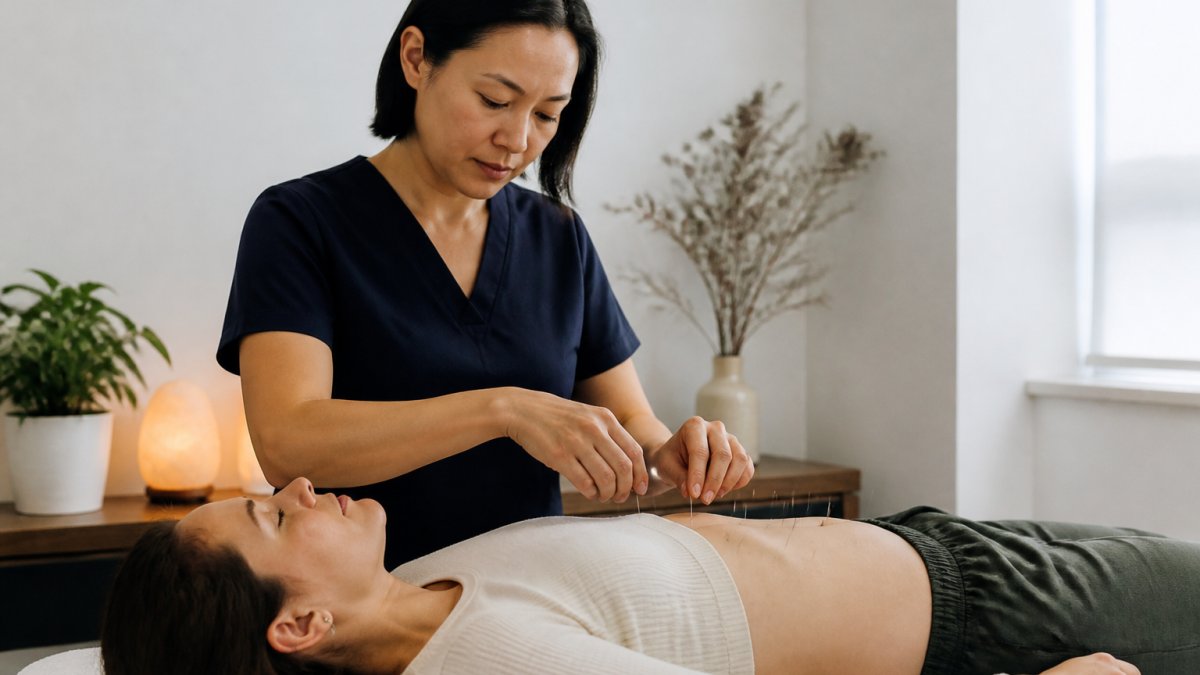
Needles used in fertility acupuncture are extremely fine, and most people describe the sensation as a dull ache or heaviness rather than sharp pain.
Sessions usually include points on the abdomen, legs, arms and ears. If you want the full walkthrough before committing, our page on what is involved in a typical acupuncture session covers the appointment from start to finish.
Acupuncture for IVF Support: Fitting Treatment Around Your Cycle
Acupuncture for IVF support is scheduled around your stimulation, retrieval and transfer phases rather than on a fixed weekly rhythm. Timing matters more than frequency here.
A typical pattern is a session in the weeks before a cycle begins, then treatment at agreed points during stimulation and around transfer.
Watch out: booking acupuncture in the days after transfer without telling your fertility team can create confusion about what you are doing and when.
The research base for acupuncture alongside assisted reproduction is mixed, and no responsible practitioner should promise it improves success rates. If you are preparing for a cycle, our step-by-step guide to preparing for IVF naturally sets out the groundwork worth doing first.
Fertility Herbal Medicine and What to Check Before You Start
Fertility herbal medicine uses prescribed formulas, usually taken as granules or a decoction, to support hormonal balance and general wellbeing. It is not a general supplement.
The thing nobody tells you about herbal medicine is that “natural” does not mean “no interactions”.
Watch out: buying fertility supplements online and combining them with a prescribed formula without telling either practitioner is the most common way people create a problem.
Our dispensary holds PICS GMP certification, which sets a manufacturing standard you can ask any provider about. Our page on claiming for herbal medicines explains what to have ready.
Preconception Care and Lifestyle Support for Both Partners
Preconception care is the window before conception when egg and sperm health are still responsive to change. Most guides treat it as a women’s checklist. That is a mistake.
A practical preconception plan has four workstreams: medical review, nutrient status, lifestyle load, and coordination with your fertility team. Each applies to both partners, with different emphasis. (Source: Australian government’s approach to complementary medicine)
Medical review before you start
Book a preconception check with your GP. For the partner carrying the pregnancy, this usually covers blood tests for iron, vitamin D, thyroid function and rubella immunity, plus a vaccination review. For the other partner, ask about general health screening and any medication that affects sperm production. Bring every supplement and prescription to that appointment. GPs are used to these conversations and can flag what needs a specialist referral.
Nutrient status and supplements
Nutrient needs differ by partner. For the partner carrying the pregnancy, folate and iodine are the commonly discussed basics, and a GP can advise on dose and timing. For the other partner, zinc, selenium and vitamin C are often mentioned in sperm-health discussions, but the evidence is not strong enough to justify megadoses. The practical rule: review every supplement against what you actually need, and do not stack products from different brands without telling a practitioner.
Lifestyle load for sperm and egg health
For sperm health, heat exposure matters (pubmed.ncbi.nlm.nih.gov). Laptops on laps, hot baths, saunas and tight clothing all raise scrotal temperature, and sperm production is sensitive to heat. Alcohol, smoking and sleep restriction also affect sperm parameters.
For the partner carrying the pregnancy, cycle regularity, sleep and stress load are the usual focus. Shift work and late screens disrupt hormone regulation, so protecting sleep is not a soft recommendation.
Coordination with your fertility team
If you are already seeing a fertility specialist, tell them what else you are doing. Complementary support should be disclosed, not hidden. Ask your specialist what they want to know about and when. A common pattern is to share your treatment dates at the first complementary appointment so the plan can be built around them rather than against them.
Preconception care is a two-person project with a three-month lead time for sperm health. Book the GP review, audit every supplement, cut heat and alcohol exposure, protect sleep, and tell your fertility team what you are doing.
How to Choose and Verify a Fertility Support Practitioner
Most clinic pages tell you to choose an experienced practitioner and leave it there. That is not a checklist. This section gives you one you can use before you book, plus the evidence framing that responsible providers should be willing to discuss.
Verify registration and qualification
In Australia, practitioners of acupuncture and Chinese medicine must be registered with the Australian Health Practitioner Regulation Agency (AHPRA). You can check registration yourself through the AHPRA register before you book. Ask for the registration number and the qualification behind it. For a fuller walkthrough, see our guide to choosing a qualified acupuncturist in Melbourne. A recognised degree in acupuncture or Chinese medicine is the baseline.
Ask about fertility-specific experience
General musculoskeletal acupuncture experience is not the same as reproductive health experience. Ask directly: how many fertility-focused patients do you see in a typical month, and how do you coordinate with fertility specialists? A practitioner who cannot describe their coordination process is a risk. You want someone who asks for your clinic’s timeline and plans around it.
Use a three-question screening call
- What is your AHPRA registration number and qualification?
- How do you coordinate with a patient’s fertility specialist, and what do you need from me?
- What is your approach if treatment is not helping after a set number of sessions?
A practitioner who welcomes these questions is usually the one worth booking. Evasiveness is information.
Scrutinise the evidence claims
The evidence base for acupuncture is reasonable for some pain conditions and mixed for fertility outcomes. No responsible practitioner should promise a pregnancy or claim to cure a diagnosed condition. Be equally sceptical of anyone who dismisses your medical treatment. The National Health and Medical Research Council publishes guidance on complementary medicine that is worth reading before you commit to a long plan.
Check the practical details
Ask about consultation length, what the first appointment covers, and how treatment plans are reviewed. Ask whether the practitioner keeps records you can share with your GP or specialist. If herbal medicine is part of the plan, ask about the dispensary’s manufacturing standards and whether they hold certification you can verify. These details separate a coordinated plan from a series of appointments.
Do not rely on a clinic’s own description of its credentials. Verify registration independently through AHPRA, and ask for the registration number in writing.
Here is a quick checklist of what to verify before booking a fertility support practitioner.
| Check | What to ask | Why it matters |
|---|---|---|
| Registration | AHPRA registration number and qualification | Verify independently through the AHPRA register |
| Fertility experience | How many fertility-focused patients seen monthly | General acupuncture experience is not reproductive health experience |
| Coordination | How they coordinate with fertility specialists | A practitioner who cannot describe this is a risk |
| Evidence claims | What evidence they rely on | No responsible practitioner should promise a pregnancy |
| Practical details | Consultation length and how plans are reviewed | Separates a coordinated plan from a series of appointments |
| Herbal dispensary | Manufacturing standards and certification | Ask for certification you can verify |
Book a Consultation to Discuss Your Fertility Support Plan
The first appointment is where a plan gets built or abandoned. Bring your cycle history, any recent bloods and scans, your fertility clinic’s timeline if you have one, and a list of everything you currently take.
We allow unhurried consultations, so there is time to cover your history properly rather than rushing through a standard script.
If you have been putting off asking questions about how acupuncture fits with your medical care, that is the right conversation to start.
Frequently Asked Questions
What does holistic fertility support involve?
A holistic fertility plan usually combines several complementary therapies rather than relying on one. That can include fertility acupuncture, herbal medicine prescribed by a qualified practitioner, nutrition and lifestyle guidance, and stress management. The aim is to support your general health and wellbeing alongside any medical fertility treatment you are having. Ask any provider what each therapy is intended to do, how many sessions they suggest, and how they will coordinate with your fertility specialist or GP.
Can acupuncture be used alongside fertility treatment?
Many people use fertility acupuncture as a complementary therapy while undergoing fertility treatment, and it is generally used alongside rather than instead of medical care. Tell your fertility specialist and your acupuncturist about each other so timing around procedures can be planned sensibly. Ask your acupuncturist about their experience with clients in treatment cycles and whether they will liaise with your medical team. Do not stop or change prescribed medication without speaking to your doctor first.
What should I know before considering herbal medicine while trying to conceive?
Herbal medicine is not automatically safe just because it is natural. Some herbs can interact with fertility medications or other prescriptions, and some are not recommended during pregnancy. Only take fertility herbal medicine prescribed by a qualified practitioner who knows your full medication list and your treatment plan. Ask about their qualifications, how the herbs are sourced and dispensed, and tell your fertility specialist what you are taking. If you become pregnant, check with your practitioner before continuing anything.
How do I choose a fertility support practitioner?
Start with registration and scope of practice. In Australia, check that an acupuncturist or Chinese medicine practitioner is registered with the Chinese Medicine Board of Australia through AHPRA. Ask how long they have been in practice, what proportion of their caseload involves fertility support, and whether they will work alongside your fertility specialist. Ask about fees and rebates up front, including whether they are a HICAPS provider for your health fund. A practitioner who welcomes these questions and sets realistic expectations is a good sign.
Fertility care involves a lot of waiting and a lot of conflicting advice. Having one practitioner who knows your full picture, coordinates with your specialist and adjusts as things change makes the process easier to manage. Book a consultation with Acupuncture to discuss your history, ask the questions you have been holding, and leave with a clear plan.


