
Table of Contents
- Why Choosing the Right Acupuncturist Matters
- AHPRA Practitioner Registration Check: The First Step
- Training, Qualifications and Professional Standards
- Clinical Experience, Specialisation and Treatment Approach
- Safety, Hygiene and Infection Control
- What to Expect at Your First Acupuncture Session
- How to Prepare for an Acupuncture Appointment
- Questions to Ask and Red Flags to Watch For
- Comparing Practitioners at a Glance
- Frequently Asked Questions
Last Updated: October 7, 2026
Why Choosing the Right Acupuncturist Matters
When you choose an acupuncturist, the decision shapes whether acupuncture feels like a genuine clinical relationship or a series of disconnected appointments. If you are searching for how to choose an acupuncturist 2026, the decision comes down to three things: verified registration, relevant clinical experience, and a treatment approach that fits your health goals. (Source: AHPRA’s public register of practitioners)
Most people start with location and price. That is backwards. A practitioner five minutes away who cannot explain their reasoning is worth less than one twenty minutes away who can.
Patients who ask structured questions before booking tend to stay in treatment longer and report better communication. The five checks below cover registration, training, experience, safety, and fit.
AHPRA Practitioner Registration Check: The First Step
An AHPRA practitioner registration check is the fastest way to confirm a practitioner meets national standards. The Australian Health Practitioner Regulation Agency maintains a public register of registered health practitioners, including Chinese medicine practitioners, and searching it takes under a minute.
How to Search the Public Register
Go to the AHPRA website and use the public register search. Enter the practitioner’s name and select Chinese medicine as the profession. The register shows registration status, registration type, any conditions or restrictions, and the registration number.
Three things to verify:
- The registration is current, not lapsed or suspended
- There are no conditions limiting their scope of practice
- The registration type matches the care you need
If a practitioner cannot be found, ask why before booking. Anyone presenting as a Chinese medicine practitioner or acupuncturist should be registered.
What Registration Does and Does Not Tell You
Registration confirms a practitioner has met the education and competency requirements set by the Chinese Medicine Board of Australia and is subject to the profession’s complaints and disciplinary processes.
It does not tell you whether they are good at treating your specific problem. Registration is a floor, not a ceiling. For the official framework, see AHPRA’s public register of practitioners.
Training, Qualifications and Professional Standards
Formal training is where registration begins. In Australia, Chinese medicine practitioners complete an accredited degree covering acupuncture, Chinese herbal medicine, or both, alongside biomedical sciences.
The qualification alone says little about continuing development.
Ask what additional training they have completed since qualifying. Dry needling, sports injury management, fertility-focused education, and pain science all sit outside the core degree.
Professional association membership is a useful secondary signal. It typically requires ongoing education and a code of conduct, which sits alongside rather than replaces registration.
Ask which accredited school the practitioner trained at and whether they hold a four-year degree or a shorter qualification. The answer tells you how much supervised clinical practice they completed before treating patients independently.
Clinical Experience, Specialisation and Treatment Approach
Clinical experience matters most when it overlaps with your situation. A practitioner with twenty years treating musculoskeletal pain may not be right for fertility support, and vice versa. Find the one whose experience maps onto your concern.
A Three-Part Test for Relevant Experience
When you call to book, describe your situation and listen to how the conversation unfolds. You are testing three things:
- Do they ask clarifying questions? A practitioner with relevant experience will want to know when symptoms started, what makes them better or worse, what you have tried, and what your doctor has said. Vague reassurance without questions is a warning sign.
- Can they describe a typical pattern? Ask what treatment usually looks like for someone with your concern, roughly how many sessions before a review, and what changes they would look for. You are not asking for a guarantee, just evidence they have walked this path before.
- Do they name their limits? Good practitioners say when something sits outside their scope and suggest who might help instead. That honesty is a strength.
How Specialisation Shows Up in Conversation
Specialisation is rarely a formal label. It shows in the language a practitioner uses:
- Pain and injury: do they discuss assessment, movement patterns, and how they coordinate with physiotherapists or GPs?
- Fertility and hormonal health: do they talk about cycle tracking, timing, and working alongside your medical team rather than instead of it?
- Stress, sleep and general wellbeing: do they ask about lifestyle patterns, sleep quality, and what else is happening in your life?
If the answers stay generic, the practitioner may not have depth in your area.
Treatment Approach: Traditional, Integrated, or Both
Practitioners vary in how they frame their work. Some lean heavily on traditional Chinese medicine diagnosis, pulse, tongue, and pattern differentiation. Others integrate modern clinical assessment alongside traditional frameworks.
Ask directly: “How do you decide what treatment I need, and how will we know if it is working?” A clear answer describes a process, assessment, a trial period, review points, rather than a promise.
Evidence, Uncertainty, and Realistic Expectations
A practitioner worth choosing will talk about what is well supported, what is uncertain, and what is outside the scope of acupuncture. Research varies by condition, and the evidence base is stronger for some concerns than others. You do not need them to recite studies, but expect them to:
- Avoid claiming acupuncture cures specific named diseases
- Describe benefits in terms of symptom management, comfort, or support alongside other care
- Acknowledge when the evidence is limited or mixed
If a practitioner promises a cure, dismisses your medical treatment, or claims acupuncture is effective for a condition where the evidence does not support it, look elsewhere. Realistic practitioners describe what they hope to help with, how they will measure progress, and when to try something different.
Safety, Hygiene and Infection Control
Safety is where you should be least willing to compromise.
What to look for in the clinic:
- Single-use, sterile, disposable needles opened in front of you
- Practitioners who wash or sanitise hands before and after treatment
- Sharps containers for immediate needle disposal (Source: Chinese Medicine Board of Australia’s continuing professional development guidelines)
If you see needles reused, packaging opened in advance, or a neglected treatment room, leave.
Ask about their infection control procedures and whether they follow their professional body’s guidelines.
Informed consent matters too. You should be told what the treatment involves, what sensations to expect, and what alternatives exist.
A practitioner who guarantees a cure, dismisses your medical treatment, or tells you to stop prescribed medication is a red flag. Registered practitioners work alongside your doctor, not instead of them.
What to Expect at Your First Acupuncture Session
Your first appointment is longer than follow-ups and includes a full health history.
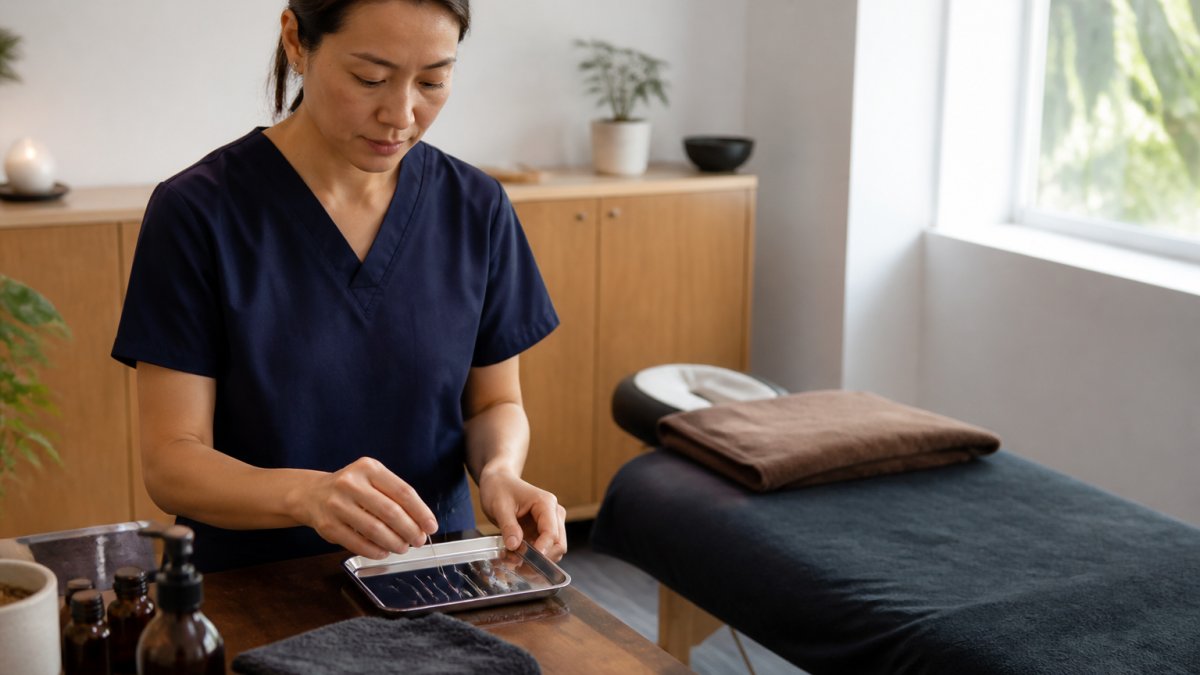
Needles are fine, typically much thinner than those used for injections or blood tests.
You will usually rest with the needles in place before they are removed. Many people find the session deeply relaxing.
Your practitioner should then outline a treatment plan: how often to come, how many sessions before assessing progress, and what improvement would look like.
How to Prepare for an Acupuncture Appointment
Preparing for an acupuncture appointment is straightforward, and a little preparation improves the session.
- Eat something light an hour or two beforehand. Arriving on an empty stomach can leave you lightheaded.
- Avoid alcohol on the day of treatment.
- Wear loose clothing that allows access to your arms, legs, and abdomen.
Tell your practitioner if you are pregnant, have a pacemaker, take blood-thinning medication, or have a bleeding disorder. If you feel faint during a session, mention it immediately.
Questions to Ask and Red Flags to Watch For
A short, structured conversation before booking will tell you more than any website. Use these questions as a script, and pay attention to how the practitioner answers as much as what they say.
Questions Worth Asking Before You Book
- Are you registered, and what is your registration number? (You can verify this yourself on the public register.)
- What training and qualifications do you hold, and where did you study?
- How much experience do you have with my specific concern?
- What would a treatment plan look like for me, roughly how often, and how will we review progress?
- What are your infection control procedures?
- How do you coordinate with my doctor, specialist, or fertility team?
- What does informed consent look like in your practice, what will you tell me about risks, alternatives, and what to expect?
- How do you decide when to stop or change approach if something is not helping?
You are not looking for perfect answers. You are looking for a practitioner who engages with the questions rather than deflecting them.
What Informed Consent Should Include
Informed consent is more than signing a form. Before treatment, you should be told:
- What the proposed treatment involves and what sensations to expect
- The likely number of sessions before a review, without a guaranteed outcome
- Reasonable alternatives, including doing nothing or continuing with other care
If any of these are missing, ask. A practitioner who welcomes the question usually communicates well throughout treatment.
Red Flags to Take Seriously
- No registration, or reluctance to provide a registration number
- Promises to cure a named disease or condition
- Advice to stop prescribed medication or skip medical treatment
Any one of these is enough to keep looking. You are not being difficult by expecting clear answers, you are being a careful patient.
Costs, Insurance, and Treatment Plans
Costs and treatment plans vary between clinics, and private health insurance rebates depend on your fund and level of cover. Before you commit:
- Ask what the initial consultation and follow-up sessions involve, and how they are structured
- Check with your fund whether acupuncture is covered under your level of cover, and what you need to claim
- Ask the clinic what they provide for claiming, receipts, provider numbers, or on-the-spot claiming where available
A reasonable treatment plan describes milestones and review points rather than a fixed number of sessions sold in advance. If a plan feels pressured or unclear, it is fine to say you would like to think about it.
Comparing Practitioners at a Glance
| What to Check | How to Verify | Why It Matters |
|---|---|---|
| Registration | AHPRA public register | Confirms national standards met |
| Qualifications | Ask directly | Shows depth of formal training |
| Relevant experience | Ask about your condition | Predicts treatment fit |
| Hygiene | Observe the clinic | Reduces infection risk |
| Treatment plan | Ask for milestones | Sets realistic expectations |
| Insurance | Check with your fund | Affects out-of-pocket cost |
Finding a practitioner who is registered, experienced in your area of concern, and willing to explain their reasoning takes a little effort, but it is the difference between treatment that feels considered and treatment that feels generic. At Acupuncture, our team brings over 40 years of clinical experience, precise low-pain needling techniques, and personalised treatment plans with no rushed sessions, supported by a PICS GMP-certified herbal dispensary and HICAPS claiming for participating health funds.
Frequently Asked Questions
How do I verify if an acupuncturist is registered with AHPRA?
Visit the AHPRA website and use the public register search. Enter the practitioner’s name to check they hold current registration as a Chinese medicine practitioner. The register shows registration status, any conditions or restrictions, and the registration type. Registration must be renewed annually, so check the expiry date. If the practitioner does not appear, ask them directly about their registration status before booking.
What qualifications should I look for in an acupuncturist?
In Australia, registered Chinese medicine practitioners complete an accredited degree, typically a four-year bachelor program covering acupuncture and Chinese herbal medicine. Look for a practitioner who holds current AHPRA registration and is a member of a professional association. Ask about their formal training, continuing education and how long they have been in clinical practice. A practitioner with specific experience in your health concern is often a better fit.
Is acupuncture regulated in Australia?
Yes. Chinese medicine practitioners, including acupuncturists, are registered through AHPRA under the National Registration and Accreditation Scheme. This means they must meet approved qualification standards, complete continuing professional development, and comply with professional conduct requirements. Registration is not permanent and must be renewed. You can verify any practitioner’s status on the AHPRA public register before booking an appointment.
What questions should I ask during an initial acupuncture consultation?
Ask about the practitioner’s qualifications and registration, their approach to your specific concern, how many sessions they typically recommend, and what results you might reasonably expect. Also ask about needle technique and what sensations to expect, hygiene and infection-control procedures, and whether they work alongside your other healthcare providers. A good practitioner welcomes these questions and gives clear, direct answers.
How can I check a practitioner’s clinical experience?
Ask how many years they have been in practice, whether they treat your specific condition regularly, and if they have worked in multidisciplinary settings. Professional association membership often indicates ongoing education. You can also ask whether they have experience working with your GP or specialist. Clinical experience matters, but so does whether the practitioner listens carefully and explains their reasoning clearly.
Who is not a good candidate for acupuncture?
People with certain bleeding disorders, those taking blood-thinning medication, or anyone with an active infection at the needle site should discuss acupuncture with their doctor first. Pregnant women should tell their practitioner before treatment. Acupuncture is generally considered low-risk when performed by a registered practitioner using sterile, single-use needles, but individual circumstances vary. Always consult your GP if you have concerns.


