
Table of Contents
- Understanding the Anxiety-Insomnia Cycle
- Herbal Remedies for Anxiety Insomnia
- Sleep Hygiene Practices That Calm a Racing Mind
- Breathing Exercises for Anxiety and Bedtime Wind-Down
- Acupuncture for Anxiety and Insomnia
- Circadian Rhythm Alignment and Somatic Tracking
- Conclusion: Building Your Personal Wind-Down Routine
- Frequently Asked Questions
Last Updated: September 19, 2026
Understanding the Anxiety-Insomnia Cycle
Anxiety and insomnia feed each other in a loop that gets harder to break the longer it runs. Worry keeps the nervous system alert at bedtime, sleep loss makes the next day’s worries feel bigger, and the cycle repeats. This guide from Acupuncture covers natural remedies for anxiety insomnia, from herbs and breathing work to acupuncture and daily rhythm fixes.
Anxiety triggers stress hormones that keep your heart rate up and your mind scanning for threats, blocking the wind-down your body needs to fall asleep. The racing mind at 2am is not a character flaw, it is a nervous system stuck in the wrong gear.
Anxiety insomnia is a sleep disorder where persistent worry or hyperarousal delays sleep onset and disrupts sleep through the night. It differs from ordinary sleeplessness because the anxiety does not switch off when the lights go out.
Natural remedies for anxiety insomnia work best when they target both sides of the loop at once. Calming herbs alone rarely fix a mind that has no wind-down routine. Breathing exercises alone struggle against a body clock that is out of step.
Herbal Remedies for Anxiety Insomnia
Several herbs have a long history of calming the mind and preparing the body for sleep. The most studied include valerian root, passionflower, chamomile, lavender oil, lemon balm, hops, and kava.
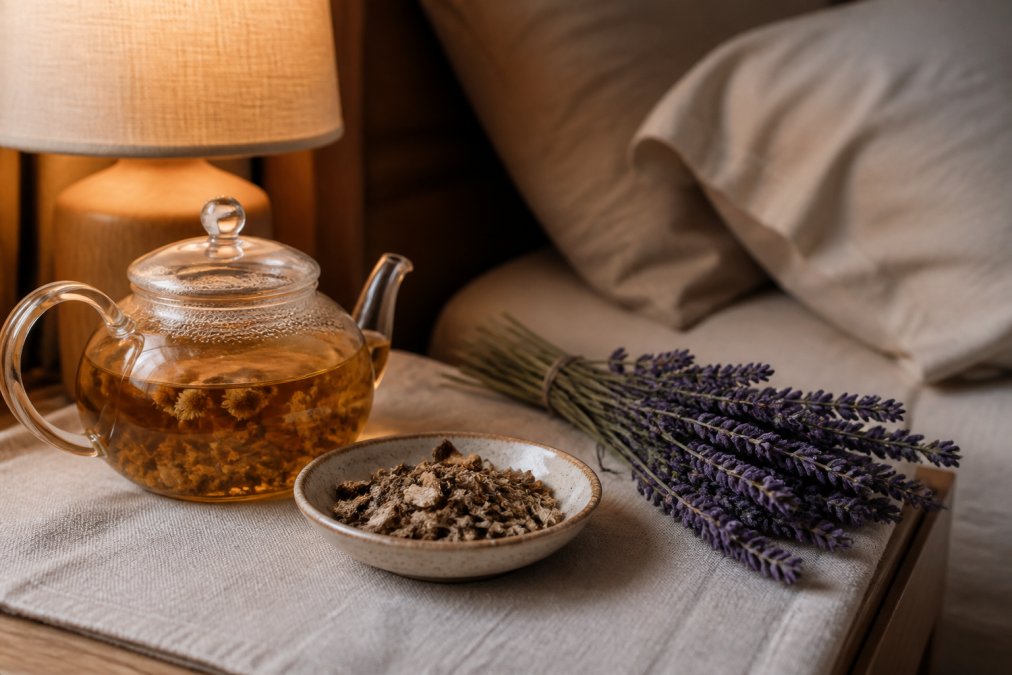
A common mistake is treating all herbal supplements as interchangeable. Each works differently, and some interact with prescription medicines.
Valerian Root, Passionflower, and Lemon Balm
Valerian root is the most widely used herb for sleep. It appears to increase the availability of gamma-aminobutyric acid (GABA), the brain’s main inhibitory neurotransmitter, which can shorten the time it takes to fall asleep. Effects build over one to two weeks rather than on the first night.
Passionflower is often paired with valerian. Some clinical trials suggest it reduces anxiety before sleep without the grogginess of sedatives, thought to modulate GABA activity more gently.
Lemon balm is a mint-family herb with mild sedative effects, often taken as an evening tea, that may reduce the restlessness that keeps people awake.
Chamomile is gentler still. A cup before bed is a ritual as much as a remedy, preparing and sipping a warm drink is itself a wind-down cue.
Lavender oil is usually inhaled rather than swallowed.
Whole dried herbs from a dispensary you trust beat bargain-bin capsules. The active compounds fade with age and poor storage, so check the batch date before you buy. In Australia, therapeutic herbs are regulated by the Therapeutic Goods Administration (TGA), and a product carrying an AUST L number has been listed, but listing is not the same as proof of effectiveness.
Safety, Dosage, and Drug-Herb Interactions
Herbal does not mean harmless. Valerian, kava, and hops can all cause adverse reactions, and kava in particular has been linked to liver concerns with long-term high-dose use.
- Sedatives or sleeping tablets (benzodiazepines such as temazepam, or Z-drugs such as zopiclone). Valerian, kava, and hops all add to the sedative effect, which can cause dangerous over-sedation and next-day impairment.
- Antidepressants, including SSRIs (such as sertraline, escitalopram, and fluoxetine). Kava and St John’s wort can interact with serotonin pathways, raising the risk of serotonin syndrome. St John’s wort also reduces the effectiveness of many prescription medicines by speeding up liver enzymes.
- Blood-thinning medication (warfarin, aspirin, clopidogrel). Some herbs affect platelet function or alter how warfarin is metabolised, which can change your INR and bleeding risk.
- Thyroid medication (levothyroxine). Some herbal preparations can interfere with absorption if taken at the same time.
- Liver-metabolised prescription drugs. Many medicines are broken down by the same liver enzymes that process herbal compounds, so one can change the level of the other in your blood.
Stop any herb and seek medical advice if you develop yellowing of the eyes or skin, dark urine, unusual fatigue, or right-sided abdominal pain. These can be signs of liver injury, which is rare but serious.
How Long Before Herbs Work
Herbs are not sleeping tablets. Most people notice a mild effect within a few nights and a clearer pattern after two to four weeks of consistent use. If nothing has changed after a month, review with a practitioner rather than increasing the dose.
Sleep Hygiene Practices That Calm a Racing Mind
Sleep hygiene practices are the daily habits that tell your brain the day is over. Treat them as non-negotiable.
The core habits:
- Keep a fixed wake time. Same time every day, weekends included.
- Dim the lights an hour before bed. Bright light tells your brain it is still daytime.
- Park worrisome thoughts on paper. Write tomorrow’s list before you get into bed.
- Keep the bedroom cool, dark, and quiet.
- Cut caffeine after early afternoon. It lingers longer than most people realise.
- Skip alcohol as a sleep aid. It helps you fall asleep, then fragments sleep later.
The single biggest sleep hygiene win is a consistent wake time. It anchors your body clock, which makes everything else easier.
The Two Levers Most Guides Ignore: Light and Temperature
Most sleep hygiene lists stop at the checklist above. The two levers with the strongest physiological effect are light exposure and core body temperature, and both are free.
Somatic Tracking: A Body-Based Technique for a Racing Mind
Sleep hygiene is mostly behavioural, and most anxiety advice is cognitive, reframing thoughts, challenging worries. Both have their place, but they can leave out the body, where anxiety actually lives at night.
Try it in bed when thoughts start to race:
- Scan from your jaw down to your feet, slowly.
- Find the place where tension is strongest.
- Describe the sensation to yourself in plain words, tight, hot, buzzing, heavy.
- Stay with it for a few breaths without trying to fix it.
- Move on and repeat.
Do not use alcohol, sedatives, or higher-than-recommended herb doses to force sleep. They can mask the problem, disrupt sleep architecture, and create a dependency that is harder to unwind than the original insomnia.
When Sleep Hygiene Is Not Enough
If you have kept a fixed wake time, managed light and temperature, and used a wind-down routine for several weeks and sleep is still poor, the problem is likely more than habit. Persistent insomnia lasting more than three months, or coming with low mood, is worth raising with your GP. Cognitive behavioural therapy for insomnia (CBT-I) is the first-line treatment for chronic insomnia and is often available through Medicare-subsidised mental health care plans.
Breathing Exercises for Anxiety and Bedtime Wind-Down
Breathing exercises for anxiety shift the nervous system out of fight-or-flight into a calmer state. Slow, extended exhales are the key, they signal safety to the body.
Try this sequence in bed:
- Breathe in through your nose for a count of four.
- Hold gently for a count of four.
- Breathe out through your mouth for a count of six.
- Repeat for five minutes.
Acupuncture for Anxiety and Insomnia
Acupuncture for anxiety and insomnia is a drug-free option many people use alongside existing care. Fine needles are placed at specific points to settle the nervous system and support sleep.
Circadian Rhythm Alignment and Somatic Tracking
Circadian rhythm alignment means matching daily habits to your body clock, which is set mainly by light: morning daylight tells it to wake up, evening darkness tells it to wind down.
Two habits do most of the work:
- Get outside within an hour of waking, even for ten minutes.
- Reduce bright light in the last hour before bed.
Conclusion: Building Your Personal Wind-Down Routine
The most effective approach is rarely one remedy, but a routine that stacks several small habits together, night after night.
A simple framework:
| Time Before Bed | Action | Why It Helps |
|---|---|---|
| 4-6 hours | Stop caffeine | Reduces sleep latency |
| 2 hours | Dim lights, park worries on paper | Calms a racing mind |
| 1 hour | Herbal tea, no screens | Signals wind-down |
| 30 minutes | Breathing or muscle relaxation | Settles the nervous system |
| In bed | Somatic tracking if thoughts race | Breaks the worry loop |
Frequently Asked Questions
How do I fall asleep when anxiety keeps me awake?
Start with a consistent wind-down routine: dim lights an hour before bed, try breathing exercises for anxiety such as slow 4-7-8 breathing, and keep a notepad beside the bed to write down worrisome thoughts. Natural remedies like chamomile tea, valerian root, or lavender oil may help some people, but effects vary. If anxiety keeps you awake most nights for more than a few weeks, speak to a qualified health professional about cognitive behavioural therapy for insomnia (CBT-I) or other support.
Can sleep anxiety be a symptom of insomnia?
Yes. Anxiety about not sleeping can develop into a cycle where worry about bedtime makes it harder to fall asleep, which then fuels more anxiety the next night. This is sometimes called sleep anxiety or nocturnal anxiety. Persistent insomnia symptoms lasting three months or more, on most nights, are worth discussing with a doctor or psychologist, because untreated anxiety and insomnia often reinforce each other. Early intervention usually makes the cycle easier to break.
Are herbal supplements for sleep safe to take with my medication?
Not always. Herbs such as valerian root, kava, hops, and passionflower can interact with sedatives, antidepressants, blood thinners, and some hormonal medications. Kava in particular has been linked to liver concerns in some people. Always tell your doctor and pharmacist about any herbal supplements you take, including dosage, and check with a qualified practitioner before combining them with prescription medicine. A PICS GMP-certified dispensary can help confirm quality and appropriate therapeutic dosage.
How long before natural remedies for anxiety insomnia start working?
It varies. Breathing exercises and relaxation techniques can calm the nervous system within minutes, while herbal supplements like valerian root or lemon balm may take one to two weeks of consistent use before you notice a difference in sleep latency. Acupuncture for anxiety and insomnia is often delivered as a short series of sessions, with many people reporting changes in sleep quality over several weeks. Give any approach a fair trial, and track your sleep so you can judge what actually helps.


